

Why a Teacher Intensive Matters, and Why Ballet 5:8 Is the Right Place to Grow
Great dance teachers are not just transmitters of steps. They are translators, mentors, problem-solvers, communicators, and culture-shapers. A strong teacher can change the trajectory of a student’s training, confidence, discipline, and long-term relationship to dance. That is exactly why teacher development matters so deeply.
Too often, dance educators are expected to keep teaching from instinct alone. Years of performance experience matter, of course, but teaching is its own craft. It requires pedagogical clarity, the ability to read a room, knowledge of progression, effective correction strategies, and the wisdom to know not only what to teach, but how to teach it to the dancers in front of you. Ballet 5:8’s Teacher Development Intensive is built around that reality. Rather than offering abstract theory alone, it brings teachers into an immersive environment of observation, participation, workshops, evaluation, and real-time faculty feedback.
A teacher intensive is important because teachers need training too. Just as dancers benefit from concentrated periods of focused study, educators grow when they step outside their normal routines and sharpen their skills with intention. An intensive setting creates space to reflect on habits, strengthen weak spots, ask better questions, and test new tools immediately. It gives teachers the rare opportunity to be both students and practitioners at the same time. That kind of concentrated development can have lasting effects, not only on one instructor, but on every student they teach afterward. This is especially true when the work includes classroom management, student engagement, parent communication, musicality, motivation, and curriculum design, all areas Ballet 5:8 explicitly includes in its schedule.
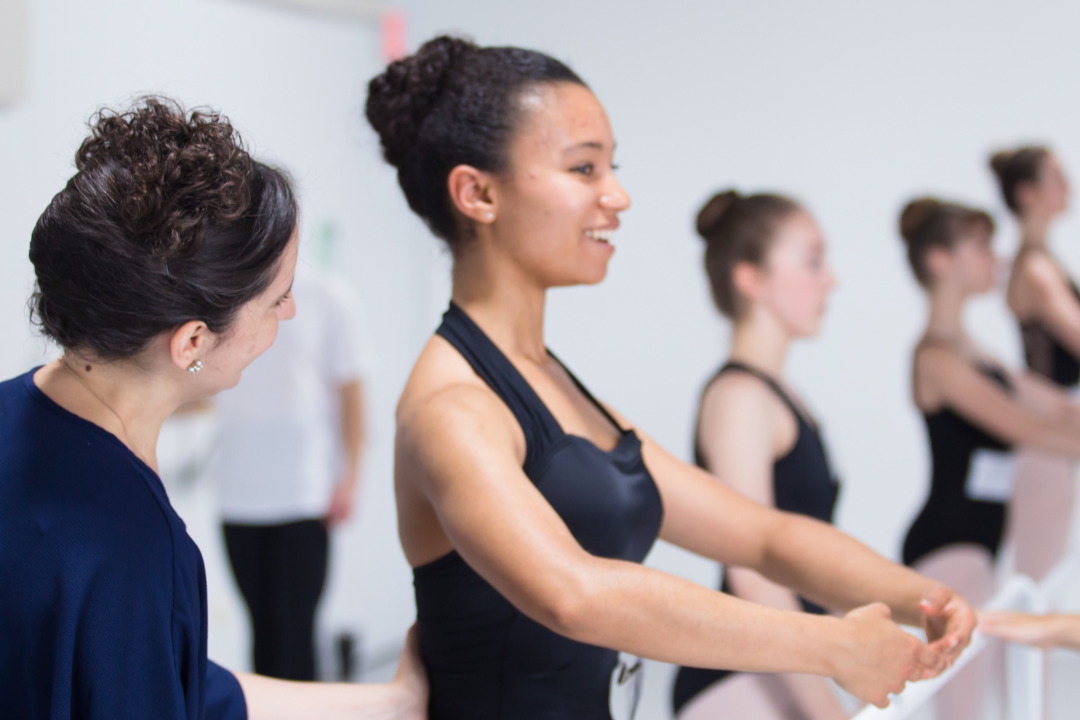
Julianna teaching Conservatory class and correcting dancer, now teacher and Second Company Member, Autumn Stull.
What makes Ballet 5:8 especially compelling is the hands-on nature of the program. This is not a passive conference where attendees sit, listen, and leave with a notebook full of ideas they may never apply. Ballet 5:8 has designed the intensive so teachers are actively engaged in the work of teaching. Participants observe advanced ballet, pas de deux, and pointe classes with clear areas of focus. They join workshops led by faculty. Full-program participants rotate through teaching evaluation sessions and receive real-time feedback on pacing, clarity, and technical emphasis. In other words, the learning is embodied, immediate, and practical.
That practical structure matters because good teaching is built in real time. It happens in the split-second decision to stop or continue. It happens in the wording of a correction. It happens in how a teacher manages energy, attention, musicality, discipline, and encouragement in the room. These are not skills most educators master by reading about them. They are learned in the studio, through doing, observing, adjusting, and trying again. Ballet 5:8’s Teacher Development Intensive is valuable precisely because it honors that truth. It is designed to help teachers hone classroom skills in the environment where those skills actually live.
The intensive also reflects something larger about Ballet 5:8’s overall training culture. Across the School of Ballet 5:8, the organization emphasizes classical rigor, personalized instruction, comprehensive curriculum, company faculty, and clear progression. The school describes its training as high-caliber and rooted in classical ballet while also being informed by the demands of today’s professional dance world. Its Conservatory and Trainee pathways highlight rehearsal standards, accountability, musical responsibility, adaptability, and consistency under performance demands. That broader culture makes Ballet 5:8 a strong place for teacher training because participants are not entering a vacuum. They are stepping into an existing ecosystem shaped by standards, structure, and artistry.
Just as importantly, Ballet 5:8 pairs standards with support. The school speaks not only about technique and performance opportunities, but also about mental health, emotional intelligence, confidence, and helping students thrive in body, mind, and spirit. That matters for teachers because technical knowledge alone does not build healthy classrooms. Strong educators must know how to lead with clarity and authority while still building trust, motivation, and meaningful student relationships. Ballet 5:8’s inclusion of workshops on student engagement, parent communication, and mentoring young dancers shows that the intensive is preparing teachers for the real human dynamics of the classroom, not just the technical ones.
For teachers looking to grow, that combination is rare: classical seriousness, practical evaluation, immediate feedback, and a broader philosophy that values both excellence and the whole dancer. It is one thing to say teacher development matters. It is another to build a program that actually develops teachers. Ballet 5:8 appears to be doing exactly that.
The result is an intensive that can serve both emerging and experienced educators. For newer teachers, it offers structure, feedback, and a stronger pedagogical foundation. For seasoned instructors, it offers refinement, reflection, and the chance to revisit their work with fresh eyes. In both cases, the benefit is the same: better teaching, stronger classrooms, and students who are more clearly guided, more deeply challenged, and more thoughtfully supported.
A teacher intensive should do more than inspire. It should sharpen. It should expose gaps, strengthen instincts, and make educators more effective the very next time they walk into the studio. Ballet 5:8’s Teacher Development Intensive, with its observation, participation, workshops, evaluations, and real-time feedback, is built for exactly that kind of growth. For teachers who want to hone their classroom skills in a serious, applied, and artistically grounded environment, it is an especially strong fit.